
Bring the full project into one global optimization.
Inputs from seven project domains enter the same optimization, interact through the model’s constraints and produce a decision-ready result set.
MiningMath explores hundreds of distinct scenarios to reveal integrated strategies and value opportunities you cannot assess otherwise.
Explore software optionsThe MiningMath difference
MiningMath solves the project as one interconnected mathematical system instead of inheriting a chain of locked answers. This retained decision freedom makes a broader search possible and lets teams compare value, operational constraints and risk exposure before committing to detailed design.
Inputs from seven project domains enter the same optimization, interact through the model’s constraints and produce a decision-ready result set.
Years until cumulative project cash flow turns positive.
Indicators can be created by the user based on the data available in the block model.
Product experience
Decision makers and engineers select one of the strongest solutions generated so far and define the next hypothesis. Automation accelerates creation, comparison and analysis.
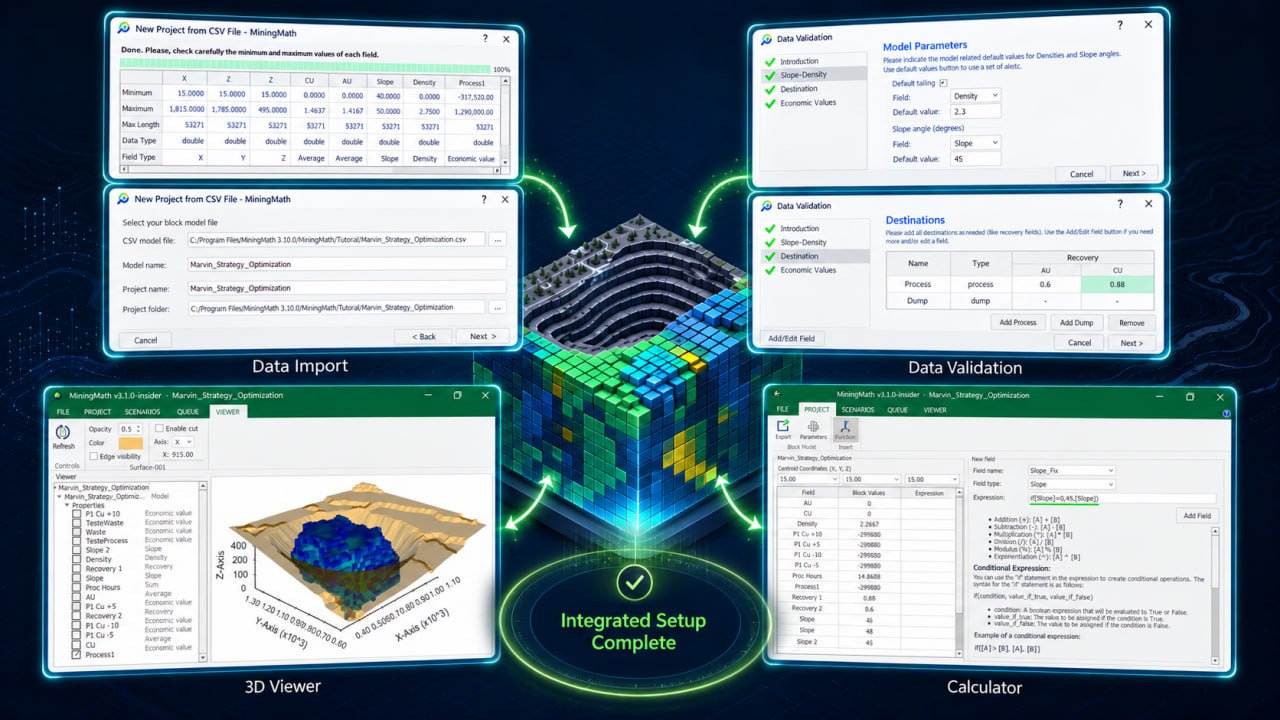
Import and validate project data and the main required parameters. Organize ranges and uncertainties for later optimization cycles. Represent each controlled variable in imported or calculated fields. Wizards guide formatting, checks and setup while reducing errors. Inputs stay open for later changes.
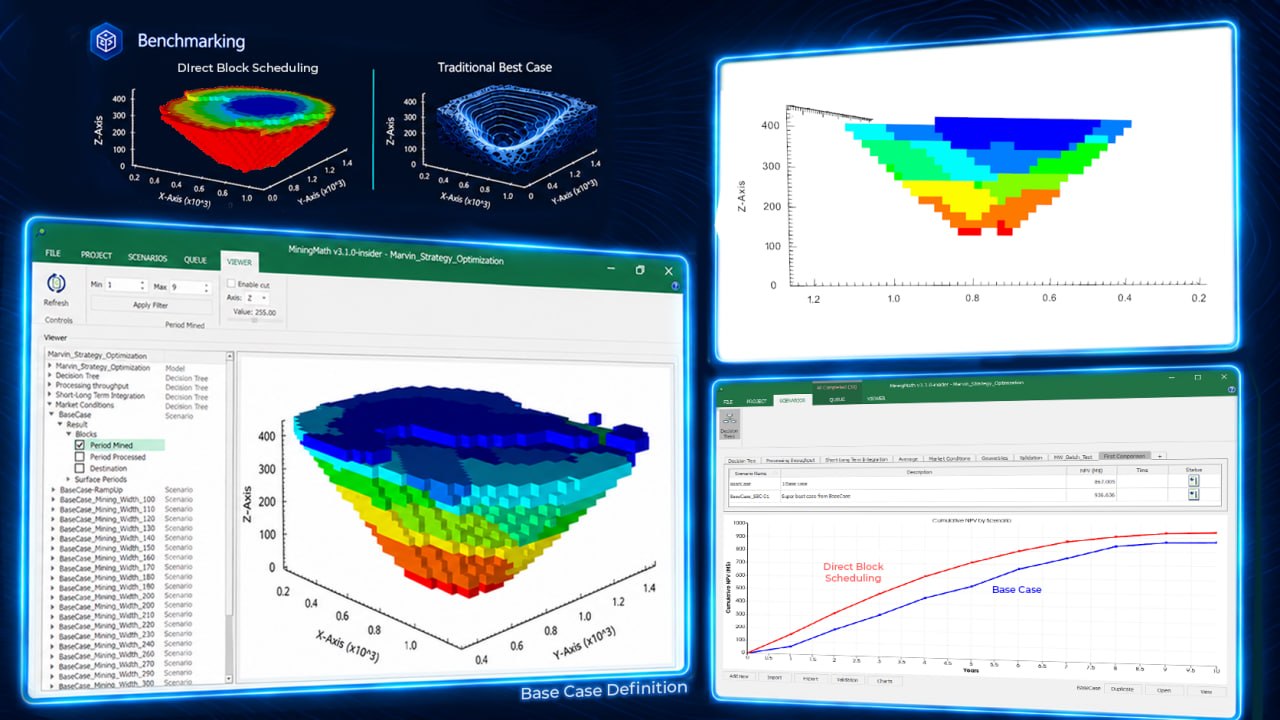
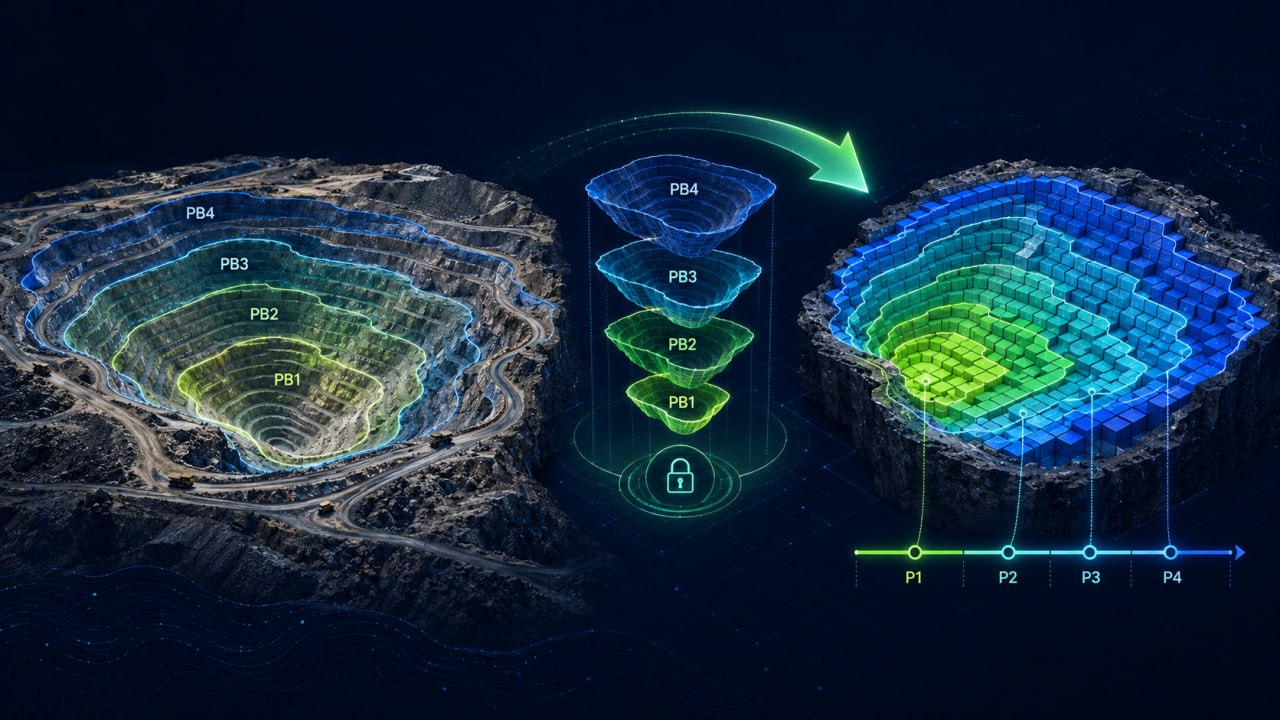
Run Direct Block Scheduling to generate optimized nested pits. Use them to benchmark against the traditional Best Case or guide standard pushback design in other software. When setting up and running the Base Case, keep relevant constraints as flexible as the project allows.
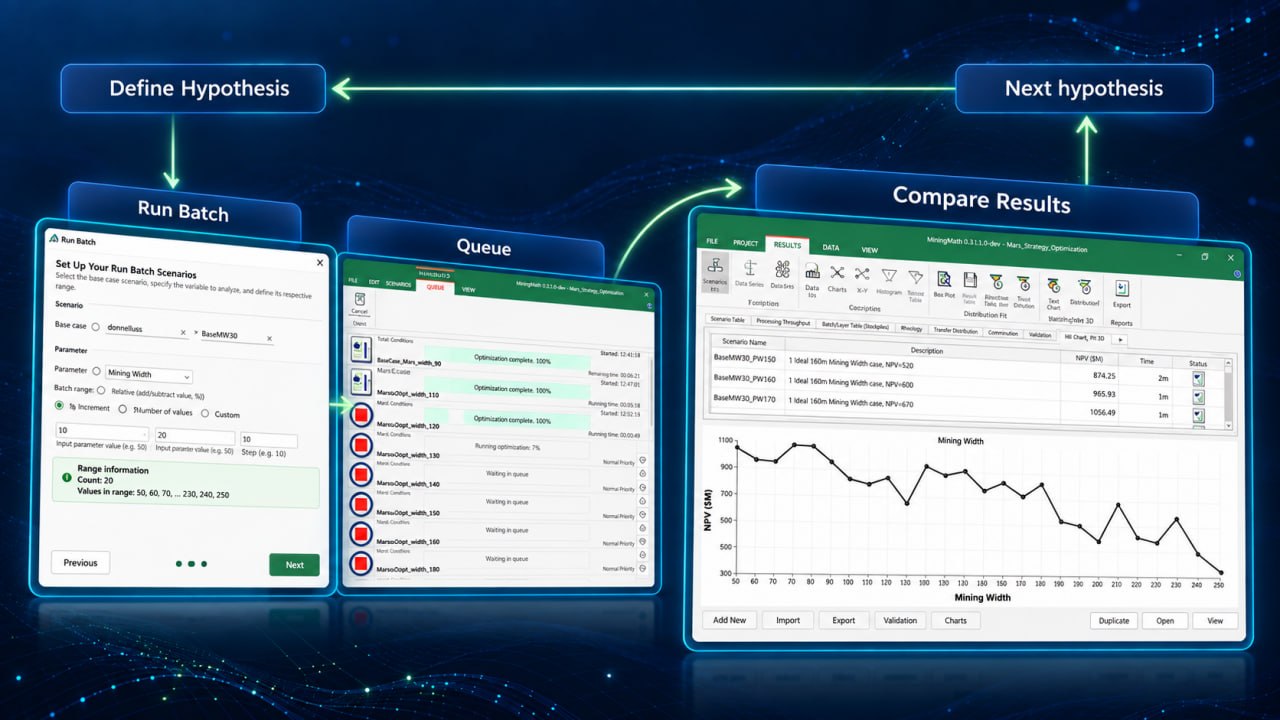
Each batch varies one chosen parameter across multiple optimized scenarios. Teams compare value, risk, operational trade-offs and the effects of each change, choose a better result as the new reference and define the next goal. The chosen scenario then advances to external mine design.
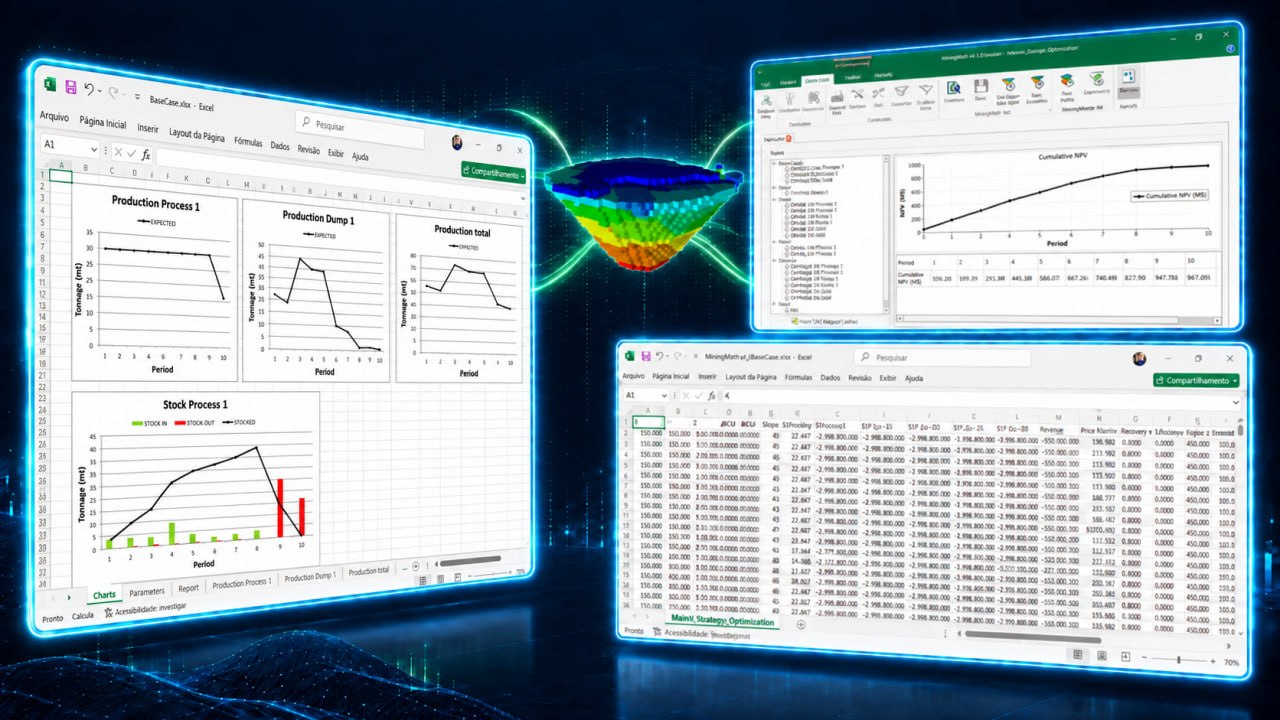
Use the optimized solution as a reference in external mine design software. Create broad pushback guidance or preserve more detail to follow the optimized plans more closely, depending on the level of detail required by the study.
Designed surfaces return to MiningMath as hard constraints. They include ramps, access routes and the required mine geometry. New optimizations search for value within tighter physical limits. Some assumptions may need review, or teams may restart the cycle under the new conditions.

Each cycle runs new optimizations while decisions remain open and risk is assessed throughout.
Prepares data and variables while keeping decisions open.
Benchmarks nested pits and establishes the study reference.
Recommended for continuous improvement.
Uses the chosen scenario for external mine design.
Uses designed surfaces as hard constraints in optimization.
Each stage inherits fixed decisions and narrows what remains possible.
Locked early; later evidence cannot reopen them.
Set before trade-offs are fully visible.
Nested pits narrow the options before scheduling.
Geometries are fixed before mine schedules are optimized.
Optimizes mine schedules within predefined aggregations.
Adds stockpiles to resolve schedule shortfalls.
Assesses risks after most strategic choices are fixed.
See a published case study comparing aspects of traditional Stepwise and Single Step methods ↗
Practice
Software editions
Optimize the mining schedule and block destinations simultaneously with MiningMath FREE.
Set up each scenario, run in a queue and make basic comparisons in the SAAS subscription.
Run scenario campaigns and make advanced comparisons with a PERPETUAL license.
Additional tailored services are available for specific project needs. Request expert assistance
Before adoption
No. MiningMath can benchmark or complement selected steps before it replaces anything. Start with one decision, compare it with the current Base Case, and expand only where the evidence justifies it. Existing tools can remain in downstream design, reporting and governance.
MiningMath produces optimized schedules, destinations, strategic stockpiling decisions and geometry-aware strategic mining shapes, not final ramp or access designs. Detailed design remains an engineering task.
No. Run Batch lets teams compare scenarios in combined charts, making trade-offs easier to review side by side. Instead of checking schedules one by one, teams can focus on the candidates that deliver the strongest results.
MiningMath AI combines proprietary global optimization, model-based search, scenario automation, comparative analysis, and natural-language interaction. Mixed-integer models and Branch & Cut procedures search complex mine-planning spaces while keeping the project’s main decisions connected. The result is an integrated decision environment, not simply an optimizer or chatbot.
Yes. A scoped proof of concept can use your own data to validate the workflow, compare targeted scenarios and deliver a decision-ready report. It gives technical and business evidence to support the next step with MiningMath.
Start with the decision, not a full rollout. Training, implementation support and project-scoped server processing can fill capability or capacity gaps. When data readiness is the blocker, the first scope can focus on validation and Base Case construction before starting a broader scenario campaign.
Custom services
Combine specialized services to validate MiningMath with your own data, build team autonomy, implement the workflow and expand processing capacity.
Run scenario campaigns
from your Base Case to assess
value, geometric sensitivities
and operational trade-offs
in a decision-ready report.
Build team autonomy
using your own data,
customized exercises and
direct guidance tailored
to your project context.
Integrate MiningMath into
your planning process, align
roles and review standards,
and deliver the first studies
with expert guidance.
Use more powerful servers
to shorten processing time,
run more scenarios,
compare more alternatives
and reach decisions sooner.